
Controlling Plants
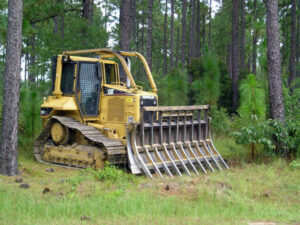
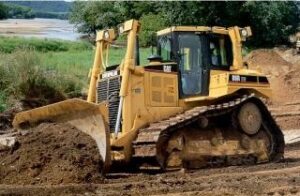
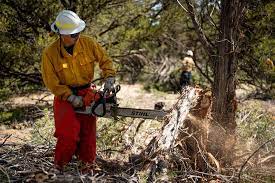
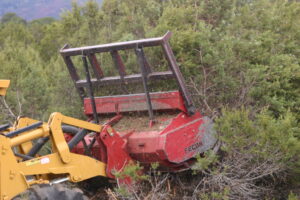
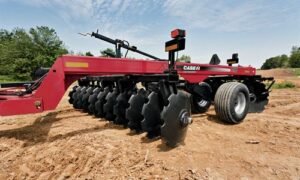
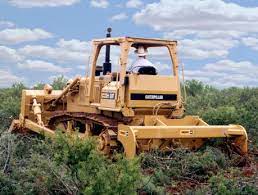
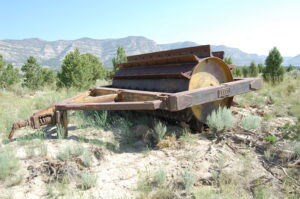
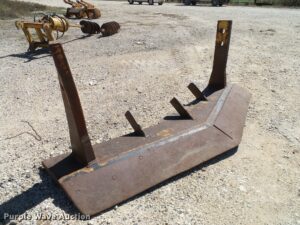
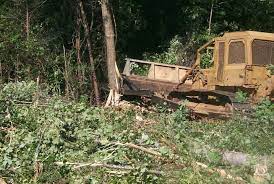
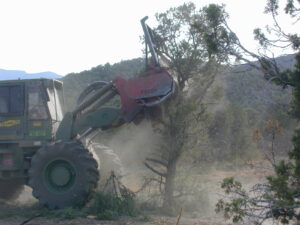
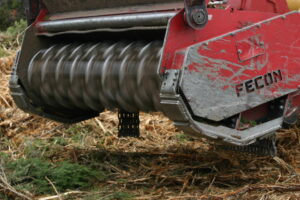
Equipment covered in this section is designed to mechanically remove invasive weeds, shrubs, and trees that would impede the revegetation of sites to plants that are ecologically adapted. Combinations of different mechanical treatments are often necessary to achieve desired results. Effectiveness of mechanical control depends on:
- selection of proper equipment and its method of application
- targeted plant and its sprouting characteristics
- site potential
- soil type
- topography and terrain
Mechanical treatments are visually apparent and usually effective, but they can be more costly than other methods. They may be the only solution when herbicide or fire cannot be used.
Biological Control
A variety of herbivores, mites, insects, and pathogens are used to reduce and suppress weed populations. Released mites, insects, and pathogens are first tested for host-specificity. Herbivores are not host specific, and their effectiveness requires careful management.
This is a complex process and very species specific that is rapidly evolving. Check with your local weed control agency or office for assistance.
Chemical Control
Chemicals are often used for control of invasive weeds and brush that hamper revegetation efforts on rangelands. Agricultural herbicides undergo extensive toxicological, environmental, plant efficacy, and cost-benefit tests before being released for widespread use. This database of knowledge enables the applicator to select herbicides to fit the targeted weeds and brush for maximum efficacy, efficiency, safety, and economics. The major change in application practice has been a shift from broad-scale aerial applications to individual plant treatments with ground equipment. In either case, the application equipment has been designed for more precision and safer use. Global positioning systems (GPS) and geographic information systems (GIS) on aircraft or ground units allow the operator to "sculpt" the landscape for multiple land-uses, e.g. wildlife habitat, grazing, water harvesting, and aesthetics. Herbicides will continue to play a significant role both singly and in combination with fire and mechanical treatments in revegetation projects. Persons applying restricted-use pesticides must have state certified Applicator's License and follow specifications on the chemical's Product Label. It is important to note that the Directions for Use section of all pesticide product labels begin with the statement: "It is a violation of Federal law to use this product in a manner inconsistent with its labeling."
Herbicides may be applied as sprays or powders directly to plants or the soil using ground or aerial applicators. Individual trunk treatments are used for controlling some woody species. Aerial applications are done with fixed-wing aircraft or helicopters. Boom-type ground sprayers with nozzles located along the boom are mounted on trucks, trucks, ATVs, or aircraft. Boomless, wide-angle sprayers mounted on ground rigs are used for spraying along roads and fencelines. Hand carried sprayers are used for small areas.
Control by Burning
The use of prescribed fires to control weeds and woody vegetation, improve forage health, manipulate wildlife habitat, and reduce fire-prone vegetation is well established. Revegetation projects can benefit from the use of fire alone or in combination with mechanical or chemical treatments. Prescribed burning implies the use of stated goals and a well-thought-out fire plan using recommended equipment and burning techniques. Consideration must be given to weather, vegetation, topography, and other variables. Fire can be a very cost-effective treatment and can cover large areas of varied terrain in a short time span if sufficient fine fuel is present. Burning treatments will be spotty if the fuel load is limited. Forage production and palatability is usually increased following a burn. Seeding may also be conducted following a burn. Erosion can be a problem following a fire. Escapes from planned burns present a real hazard; therefore, trained personnel and wise judgment are vital to successful prescribed fires.
References/Additional Information
Brazell, L.1981. Rangland use of the Mercedez Benz Unimog. In: 35th Annual Report of the Vegetative Rehabilitation and Equipment Workshop (VREW); 1981 February 8-9; Tulsa, OK. Missoula, MT: USDA Forest Service Equipment Development Center: 33.
DiTomaso, J.M.; Brooks, M.L.; Allen, E.B.; Minnich, R.; Rice, P.M.; Kyser, G.B. 2006. Control of invasive weeds with prescribed burning. Weed Technology. 20(2): 535-548.
Monsen, S.B. 2004. Chapter 8. Controlling plant competition. In: Monsen, S.B.; Stevens, R.; Shaw, N.L., comps. Restoring western ranges and wildlands, vol. 1. Gen. Tech. Rep. RMRS-GTR-136-vol-1. Fort Collins, CO: U.S. Department of Agriculture, Forest Service, Rocky Mountain Research Station: 57-64.
Pearson, D.E.; Ortega, Y.K.; Runyon, J.B.; Butler, J.L. 2016. Secondary invasion: The bane of weed management. Biological Conservation. 197: 8-17.
Poland, T.M.; Juzwik, J.; Rowley, A.; Huebner, C.D.; Kilgo, J.C.; Lopez, V.M.; Olson, D.H.; Pearson, D.E.; Progar, R.; Rabaglia, R.; Rothlisberger, J.D.; Runyon, J.B; Sing, S.E. 2021. Management of landscapes for established invasive species. 2021. In: Poland, T.M.; Patel-Weynand, T.; Finch, D.M.; Ford Miniat, C.; Hayes, D.C.; Lopez, V.M., eds. Invasive species in forests and rangelands of the US: A comprehensive science synthesis for the US. Heidelberg, Germany: Springer International Publishing: 133-184.
Stevens, R.; Monsen, S.B. 2004. Chapter 9. Mechanical plant control. In: Monsen, S.B.; Stevens, R.; Shaw, N.L., comps. Restoring western ranges and wildlands, vol. 1. Gen. Tech. Rep. RMRS-GTR-136-vol-1. Fort Collins, CO: U.S. Department of Agriculture, Forest Service, Rocky Mountain Research Station: 65-88.
Vallentine, J.F. 2004. Chapter 10. Herbicides for plant control. In: Monsen, S.B.; Stevens, R.; Shaw, N.L., comps. Restoring western ranges and wildlands, vol. 1. Gen. Tech. Rep. RMRS-GTR-136-vol-1. Fort Collins, CO: U.S. Department of Agriculture, Forest Service, Rocky Mountain Research Station: 89-100.
Whisenant, S.G. 2004. Chapter 11. Vegetative manipulation with prescribed burning. In: Monsen, S.B.; Stevens, R.; Shaw, N.L., comps. Restoring western ranges and wildlands, vol. 1. Gen. Tech. Rep. RMRS-GTR-136-vol-1. Fort Collins, CO: U.S. Department of Agriculture, Forest Service, Rocky Mountain Research Station: 101-120.
Winston, R.; Randall, C.B.; deClerck-Winston, R.; Floate, R.; McClay, A.; Andreas, J.; Schwarzländer, M. 2014. Field guide for the biological control of weeds in the Northwest. FHTET-2014-08. Moscow, ID: USDA Forest Service and University of Idaho Extension. 338 p.